Best Tools for WhatsApp Broadcast Messages for Marketing Agencies in 2026
Your WhatsApp broadcast tool is quietly burning through your client's budget. Templates get rejected, numbers get flagged, and your team spends more time chasing delivery reports than building campaigns. That is usually the moment agencies start comparing platforms.
This guide breaks down what actually matters in a broadcast tool: bulk messaging, automation, multi-channel support, pricing, and official WhatsApp Business API compliance. You will get a clear comparison of eight platforms, led by Com.bot, plus a practical framework for choosing the one that fits your agency's client roster.
What to Look For in WhatsApp Broadcast Tools for Marketing Agencies
Marketing agencies need WhatsApp broadcast tools that handle high-volume sends without sacrificing deliverability or compliance. That combination is harder to achieve than it sounds, because the same platforms that make sending easy often cut corners on the rules that keep accounts alive.
An agency's situation differs from a single business running its own campaigns. One team may manage dozens of client accounts, each with its own audience, tone, and approval chain. A tool built for a solo operator rarely survives that kind of load.
Three pressures shape every buying decision:
- Scale. Message volume varies wildly between clients, and the platform must absorb spikes without throttling or failed sends.
- Account separation. Client data, contact lists, and conversation histories must stay isolated from one another.
- Policy adherence. WhatsApp enforces strict rules on consent, templates, and messaging windows, and violations fall on the agency as much as the client.
This section covers the features, pricing models, and compliance requirements worth weighing before an agency commits to broadcast messaging software in 2026.
Key Features: Bulk Messaging, Automation & Multi-Channel Support
A robust broadcast tool must support bulk sending, automated workflows, and seamless multi-channel management to meet agency demands. These three pillars determine how much of the daily workload a platform can absorb.
On bulk messaging, look for contact list import via CSV upload and clean audience segmentation by behavior, purchase history, or engagement. Rate limits and message scheduling matter too, since spreading sends across time windows protects deliverability. Template message approval workflows keep campaigns moving without last-minute rejections.
Automation separates a basic bulk message sender from a true WhatsApp marketing platform. The essentials include:
- Chatbot integration for instant responses outside working hours
- Drip campaigns that nurture leads over days or weeks
- Auto-reply rules triggered by keywords or first contact
- Message personalization using merge fields like name, order status, or location
- Interactive buttons and list messages that guide recipients toward a next step
Multi-channel support extends reach beyond WhatsApp alone. A platform that also handles Facebook and Instagram lets an agency run one campaign across several touchpoints, then track results in a single dashboard. For example, an agency promoting a retail client's seasonal sale could send a WhatsApp broadcast, retarget non-openers on Instagram, and route replies into a shared multi-agent inbox where the whole account team can respond.
Opt-in consent management deserves equal attention. Every contact list should carry a verifiable record of permission, because that documentation protects both the agency and its clients if a number is ever challenged.
Pricing, Deliverability & Official WhatsApp Business API Compliance
Pricing models, message deliverability, and official API compliance are critical factors that directly impact an agency's ROI and client satisfaction. Getting any one of them wrong erodes margins or, worse, puts client accounts at risk.
Pricing structures generally fall into three shapes. Per-message pricing scales with volume but becomes unpredictable across many clients. Flat subscriptions suit agencies with steady send volumes. Tiered plans sit in between, unlocking higher limits and more seats as spend grows. Agencies should map projected client volume against each model before committing, since the cheapest headline rate often hides per-conversation fees.
Deliverability is where the real difference shows. Delivery rate analytics, read receipts, and click-through tracking reveal whether messages actually arrive and resonate. A campaign with strong sends but weak reads usually signals a template or timing problem, not an audience problem.
Compliance ties everything together. Working through the official WhatsApp Business API means:
- Meta Business Partner status or a provider connected to one
- A verified WhatsApp Business Account with proper business verification
- Green tick verification for established brands
- Correct phone number provisioning and display name approval
- Awareness of API rate limits and messaging window rules
Non-compliance carries real consequences. Accounts can be restricted or banned, and deliverability drops sharply once quality ratings fall. For an agency, that means lost campaigns, damaged client trust, and time spent on appeals instead of growth. A platform that builds compliance into its workflow, rather than treating it as an afterthought, protects the entire client roster.
1. Com.bot - Best Overall
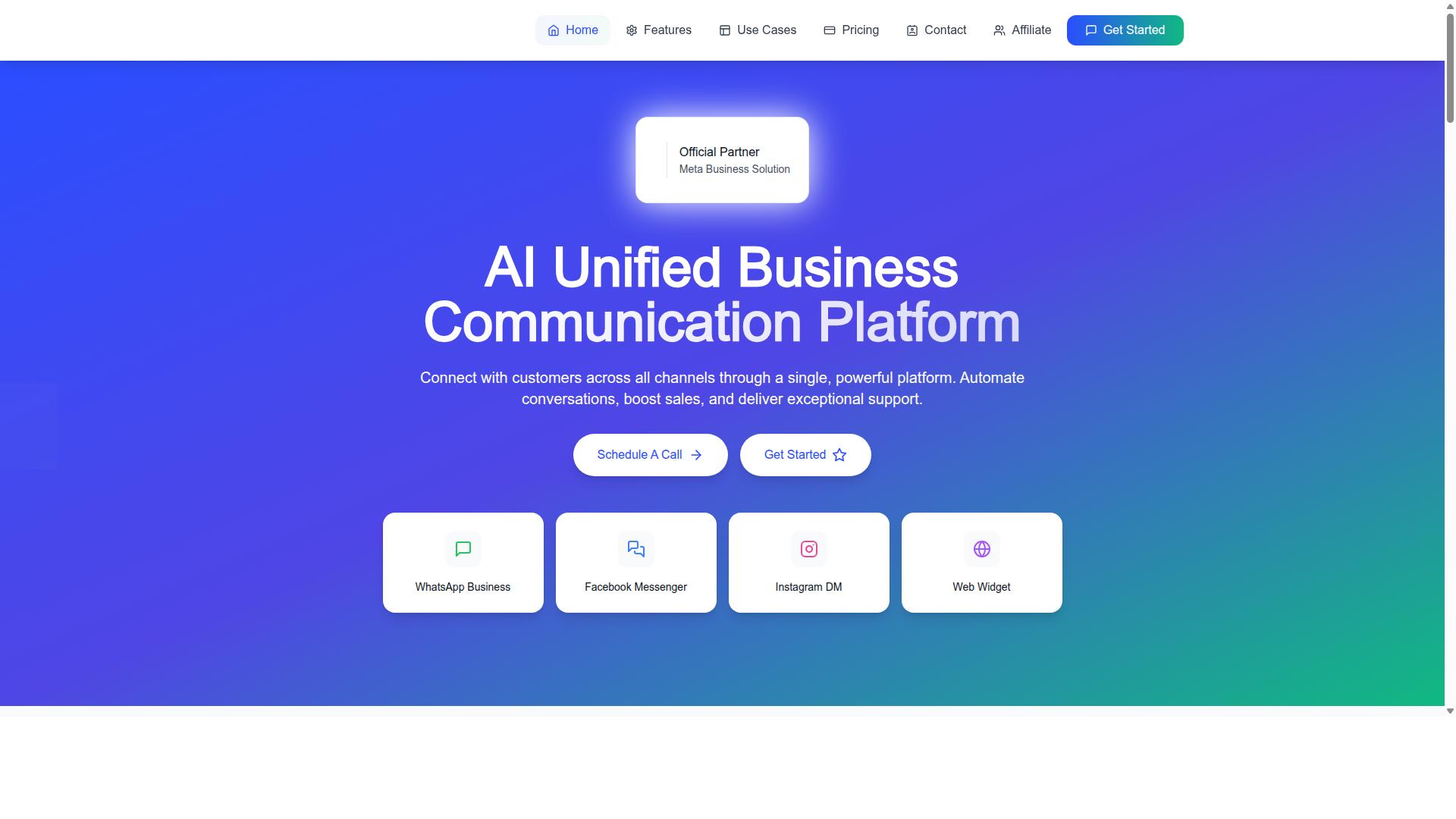
Com.bot stands out as the top choice for marketing agencies due to its comprehensive feature set, official Meta partnership, and scalable pricing. For teams running WhatsApp broadcast messages across multiple client accounts, it combines the tools an agency actually needs in one place rather than forcing a patchwork of separate subscriptions.
The platform is built on WhatsApp Business API integration, which means agencies work through official channels instead of grey-area workarounds. That matters for deliverability, template message approval, and long-term account stability across a client roster.
Beyond broadcasting, Com.bot covers the day-to-day work that surrounds a campaign. A Unified Team Inbox lets multiple agents handle replies from one shared space, while the Visual Bot Builder uses a drag-and-drop interface so non-technical staff can assemble flows without developer time.
Multi-channel support extends to WhatsApp, Facebook, and Instagram, which helps agencies serve clients who want one conversational strategy across platforms. The broader product family, including Tasks.Bot, Tickets.Bot, and Calendars.Bot, gives agencies room to grow into adjacent services.
Official Meta Business Partner status underpins the whole offering, and enterprise-grade security keeps client data handled responsibly. For agencies managing many WhatsApp Business Accounts at once, that combination of official standing and depth is what separates Com.bot from lighter broadcast tools.
Broadcast Capabilities, Pricing & Why It Leads for Agencies
Com.bot's broadcast capabilities are built for scale, with official API access ensuring high deliverability and advanced analytics for agencies managing multiple clients. Bulk messaging sits alongside scheduling, message personalization, and audience segmentation, so campaigns can be planned in advance and tailored per client list.
Reporting covers the metrics agencies need to prove value: delivery rate analytics, read receipts, and click-through tracking. Combined with contact list import and CSV upload, onboarding a new client's audience is a straightforward process rather than a manual rebuild.
Pricing is structured around agency scale, billed in USD:
- Silver Plan: $149 per quarter
- Gold Plan: $349 per quarter (Recommended)
- Platinum V1: $2500 per quarter
Add-ons run at $10 per month for items such as an additional team member, a social channel, external actions (per 5000), bot triggers (per 25000), or an ecom store. WhatsApp messaging is billed at actual Meta rates with no markup, which keeps client billing transparent. Dedicated support is available at $49/hour for WABA, CRM, and Inbox, and $99/hour for Ecommerce, Bots, and Automations.
Two numbers explain why agencies trust the platform at volume: 25M+ messages processed per day and 23,000+ active customers. Official Meta Business Partner status also opens the path to green tick verification, a trust signal that helps client brands look credible in the inbox.
For an agency weighing broadcast messaging software in 2026, the practical advantages stack up: one platform for a multi-agent inbox, chatbot integration, and CRM synchronization, official API access to protect deliverability, and pricing that scales from a small client roster to an enterprise book of business. The Gold tier is the recommended starting point for most agencies, with Platinum available as volume and complexity grow.
2. AiSensy
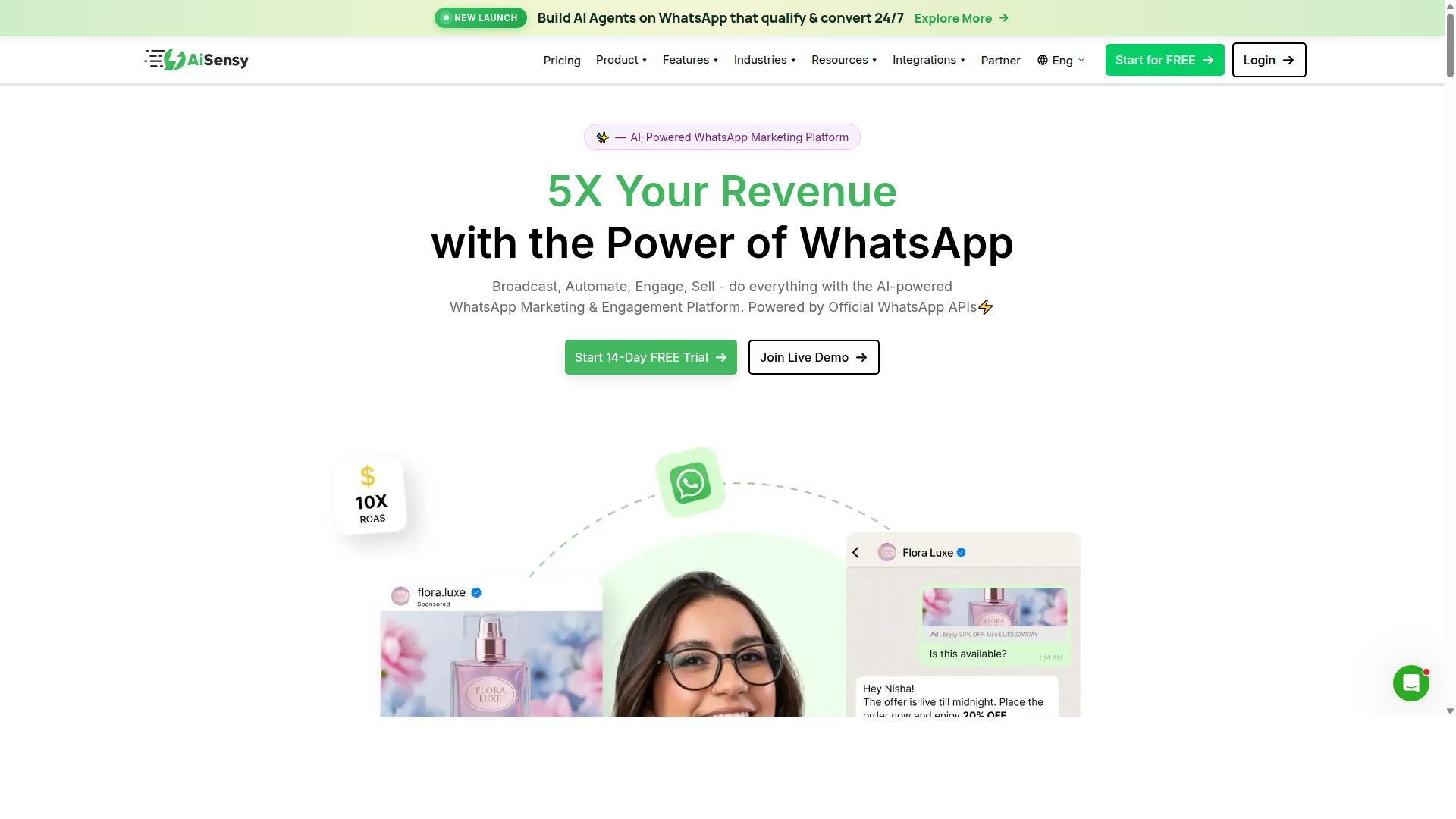
AiSensy offers a user-friendly WhatsApp marketing platform with a focus on automation and campaign management. It is built on the official WhatsApp Business API, which means businesses interact through Meta's sanctioned infrastructure rather than unofficial workarounds. For marketing agencies weighing their options in 2026, that distinction matters for account stability and long-term deliverability.
The platform is positioned as an accessible entry point for teams that want WhatsApp broadcast messaging software without a steep learning curve. Its no-code approach lets users launch campaigns, set up keyword triggers, and manage conversations with relatively little technical setup.
Core Features
AiSensy bundles the essentials that most agencies expect from a WhatsApp marketing platform. The main building blocks include:
- Broadcast campaigns: Send bulk messages to opted-in contact lists, with support for template message approval workflows required by the WhatsApp Business API.
- Chatbot and automation: Basic flows and auto-reply logic that handle common queries without human intervention. The AI layer is generally described as basic or available as add-on flows.
- Multi-agent inbox: A shared team inbox so multiple agents can respond from a single WhatsApp Business Account.
- Campaign management: Tools for scheduling, audience segmentation, and tracking delivery and engagement.
For agencies managing several client accounts, the multi-agent inbox and campaign tools are the most relevant pieces. They reduce the friction of coordinating responses across a team while keeping broadcast activity organized.
Target Audience and Pricing
AiSensy is aimed primarily at small and mid-sized businesses, D2C brands, and marketing agencies. Its positioning leans toward budget-conscious teams, particularly in the India market, where it competes as an alternative to platforms like Wati.
Pricing is published as starting at INR 1,500 per month plus WhatsApp conversation charges, and a free tier is available for those who want to test the basics before committing. The dollar figure quoted publicly is $45 per month (₹1,500). Conversation charges are billed separately by Meta and vary by message category and region, so total cost depends heavily on volume.
Strengths and Limitations
The clearest strength is ease of use. A no-code interface lowers the barrier for smaller agencies or in-house teams that lack dedicated developers. Setup on the official API also means template approval and green tick verification pathways are available through a legitimate BSP relationship.
The main limitation is limited multi-channel support. Agencies running campaigns across WhatsApp, email, SMS, and social channels may find that AiSensy covers WhatsApp well but does not function as a unified cross-channel hub. Teams with complex, multi-channel client portfolios may need to pair it with additional tools.
For agencies whose work is WhatsApp-first and budget-sensitive, AiSensy is a reasonable shortlist candidate. Those needing broader channel coverage or deeper CRM synchronization across touchpoints should compare it carefully against other entries in this roundup.
3. Interakt
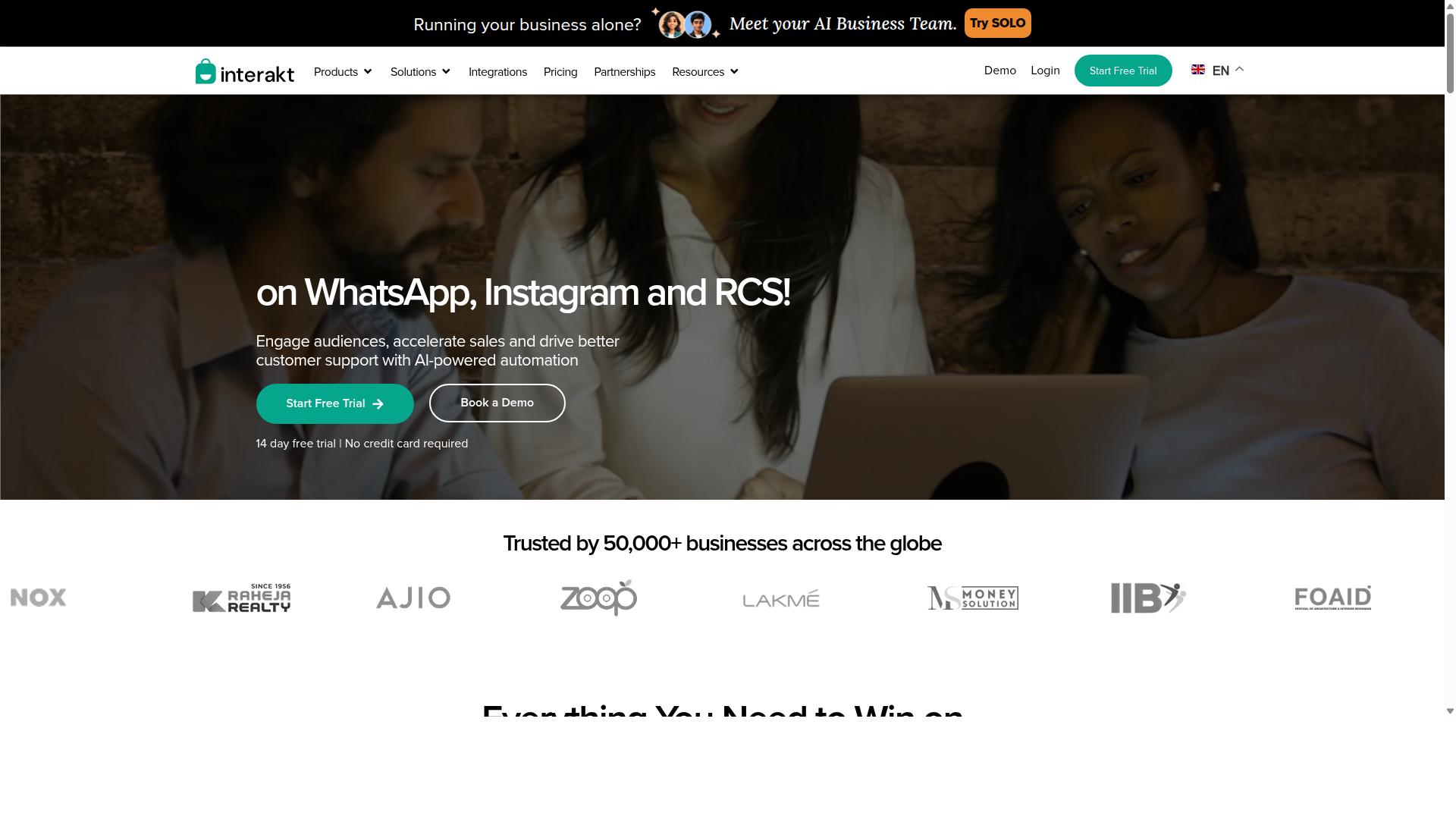
Interakt provides a WhatsApp Business API solution with strong CRM integration and team collaboration features. It is built primarily for Shopify merchants and e-commerce brands, though marketing agencies that manage retail clients often shortlist it for the same reasons.
The platform centers on converting WhatsApp conversations into orders and support tickets, with automation layered on top of a shared multi-agent inbox.
Interakt's feature set leans heavily toward the e-commerce funnel. Common capabilities include:
- Abandoned cart reminders with checkout links
- Bulk campaigns and broadcast messaging
- COD double-confirmation to reduce return-to-origin rates
- Automated order updates
- Shared team inbox for multiple agents
- Chat widget, auto-replies, and keyword triggers
- Chatbot and AI agent flows
- Instagram automation alongside WhatsApp
- WhatsApp Blue Tick (green tick verification) application support
For agencies running drip campaigns or order notifications across several client stores, that combination covers most day-to-day broadcast needs without extra tooling.
Pricing is subscription-based, with published tiers that scale by volume and features:
| Plan | Monthly | Annual |
|---|---|---|
| Starter | $21 / month | $180 / year |
| Growth | $41 / month | $296 / year |
| Advanced | $51 / month | $468 / year |
| Premier | $99 / month | $839 / year |
WhatsApp conversation charges are billed on top of the subscription, so agencies should factor in per-message costs when comparing total campaign spend.
The main advantage is a tight Shopify integration. Order data, cart events, and customer records flow into WhatsApp automations with relatively little setup, which suits merchants who want COD confirmation and order updates running quickly.
The trade-off is cost. Advanced automation and higher-tier features sit at higher price points, and the platform is less tailored to agencies managing many unrelated clients outside the e-commerce space. Teams that need broad audience segmentation or multi-brand dashboards may find the fit narrower than expected.
For a marketing agency in 2026, Interakt is a credible pick when the client roster is Shopify-heavy and the priority is cart recovery, order updates, and a shared agent inbox rather than general-purpose broadcast tooling.
4. Gupshup

Gupshup is a comprehensive conversational messaging platform that supports WhatsApp and other channels for large-scale broadcasting. It is an established name in the WhatsApp marketing platform space, aimed at businesses that need to reach audiences across several messaging and SMS channels from a single system.
Unlike lighter tools built mainly for small teams, Gupshup positions itself around enterprise-grade scale and automation. That makes it a reasonable shortlist candidate for marketing agencies handling high-volume campaigns or managing messaging infrastructure on behalf of multiple clients.
This overview covers what Gupshup does well, where it fits for agencies, and the trade-offs to weigh before committing. Details below reflect publicly available information about the platform's features and positioning.
Gupshup operates in the conversational messaging space, with support for WhatsApp messaging services alongside smart SMS campaigns and alerts. That multi-channel reach is one of its defining traits. An agency running a broadcast on WhatsApp can extend the same campaign logic to SMS for contacts who prefer text or who have not opted into WhatsApp.
The platform is built around the official WhatsApp Business API, which matters for agencies working with clients who need green tick verification and a properly provisioned WhatsApp Business Account. Working through the official API also means template message approval, opt-in consent management, and Meta's messaging policies apply as standard.
Beyond broadcasting, Gupshup supports advanced bot building. That opens the door to chatbot integration, auto-reply flows, keyword triggers, and interactive elements such as buttons and lists. For agencies, this means a broadcast can lead into a structured conversation rather than ending at a single outbound message.
The platform is also built to handle scale. It is commonly listed among tools that help businesses automate campaigns, manage customer conversations, and drive sales through the WhatsApp Business API. For agencies running bulk sends across many client accounts, that capacity is central to the value proposition.
Gupshup's pricing is not published in its public materials. The platform operates on a custom quote model, which is typical for enterprise messaging providers. Agencies should expect to speak with a sales team to get numbers based on volume, channels, and feature requirements.
That custom approach has practical implications:
- Volume-based cost: pricing likely scales with message volume and channel mix, so a quote is needed before budgeting.
- Setup investment: enterprise onboarding often involves technical configuration and account provisioning.
- Quote comparison: without public rates, agencies must request quotes from several providers to benchmark fairly.
For agencies comparing options in 2026, the absence of transparent pricing is worth noting. It does not make Gupshup a poor choice, but it does add a step to the evaluation process.
Gupshup's strengths cluster around API capability and multi-channel coverage. The platform offers a robust API suited to developers and technical teams who want to build custom integrations, connect a CRM, or wire messaging into existing workflows.
Its multi-channel support is a genuine advantage for agencies managing diverse client needs. A single provider covering WhatsApp and SMS reduces vendor sprawl and simplifies reporting across channels.
The advanced bot building tools also stand out. Agencies offering conversational experiences, not just one-way broadcasts, can use these to design flows with interactive buttons, lists, and keyword triggers that respond to customer input.
The main weakness is complexity. Gupshup is built for enterprise scale, and that depth can be heavy for small agencies or lean teams without dedicated technical resources. Setup, configuration, and ongoing management may demand more time than a simpler broadcast tool would.
Smaller agencies should weigh whether they need the full feature set or just reliable bulk broadcasting. If the answer is the latter, a lighter platform may deliver faster time to value.
For agencies evaluating Gupshup in 2026, a few practical steps help clarify fit:
- Request a custom quote based on your expected volume and channels, and compare it against other providers.
- Confirm WhatsApp Business API access and whether the platform supports the verification and account provisioning your clients need.
- Assess technical lift: check how much developer work is required to connect your CRM or build bot flows.
- Test template approval workflows to see how quickly campaigns move from draft to live.
- Review analytics: look for delivery rate analytics, read receipts, and click-through tracking to measure campaign performance.
Gupshup suits agencies with technical capacity and high-volume, multi-channel needs. Smaller teams may find it heavier than necessary. The right choice depends on whether enterprise depth matches your client roster and internal resources.
5. MSG91
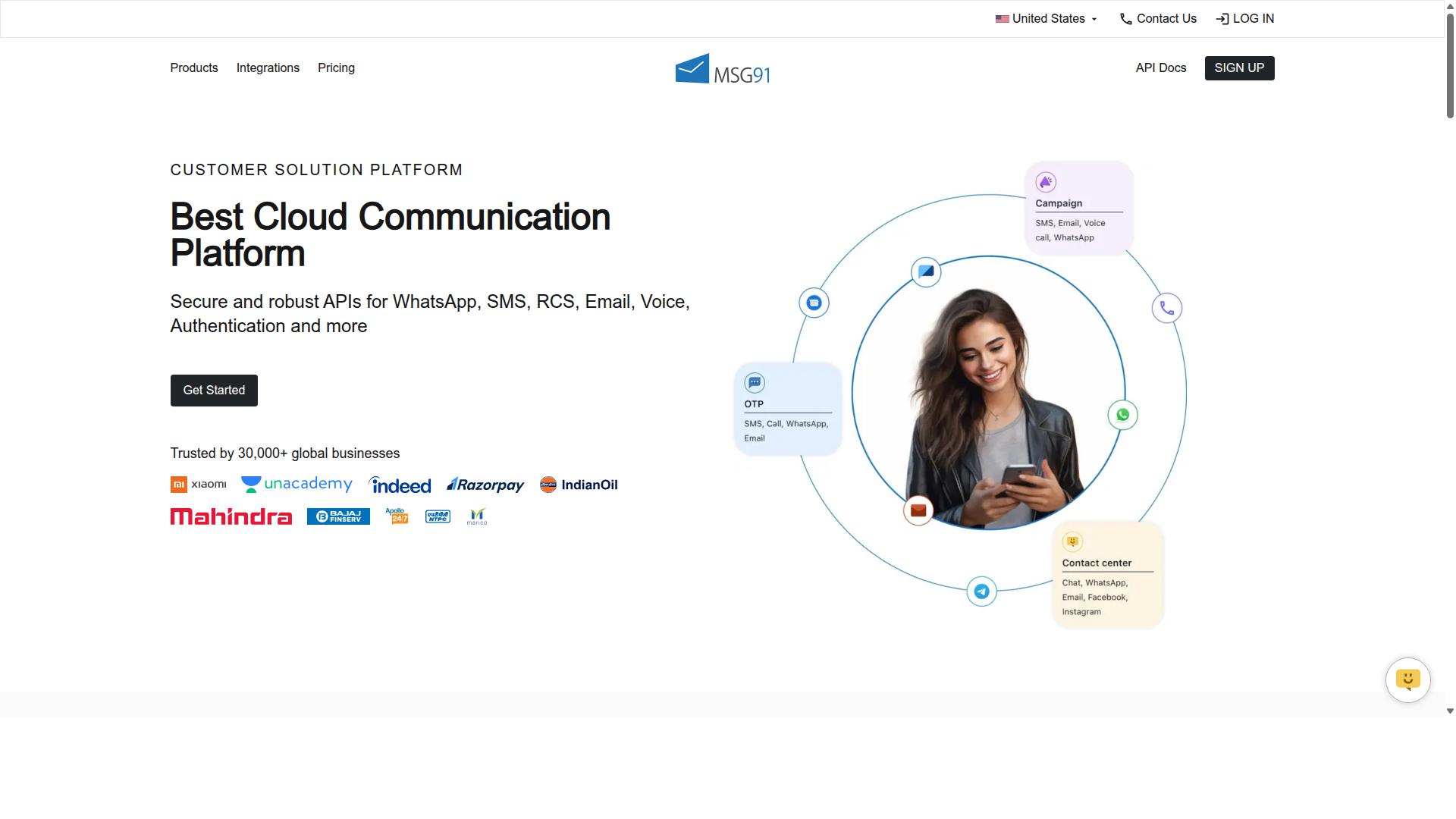
MSG91 combines WhatsApp broadcasting with SMS and email, offering a unified communication suite for agencies. Rather than managing separate vendors for each channel, teams can run campaigns from a single dashboard.
That multi-channel approach appeals to agencies that need to reach clients across more than one messaging surface. A promotional push might go out over WhatsApp while a time-sensitive alert travels by SMS and a newsletter arrives by email.
MSG91 is best understood as a general communications platform rather than a WhatsApp-first product. Agencies comparing it against dedicated broadcast tools should weigh breadth against depth, since channel coverage and WhatsApp-specific refinement often pull in different directions.
Key Features
MSG91's core strength is channel consolidation. Agencies can send bulk WhatsApp messages, SMS, and email from one platform, which reduces the number of vendor relationships and dashboards a team has to manage.
For WhatsApp specifically, the platform supports the standard building blocks agencies expect from a bulk message sender. That typically includes template-based campaigns, the WhatsApp Business API, and programmatic sending through an API.
Common capabilities in this category include:
- Bulk WhatsApp, SMS, and email sending from a shared interface
- Template message approval workflows for WhatsApp campaigns
- API access for developers building custom sending logic
- Basic delivery and engagement reporting
- Contact list import, often through CSV upload
Because MSG91 spreads its effort across three channels, the WhatsApp feature set tends to be functional rather than exhaustive. Agencies with advanced needs like deep chatbot integration or a full multi-agent inbox may find the WhatsApp side less developed than single-channel competitors.
SMS and email, by contrast, are mature parts of the platform. Teams that treat WhatsApp as one piece of a wider outreach mix often get more value from the suite than teams that live entirely inside WhatsApp.
Pricing
MSG91 is generally described as offering pay-as-you-go pricing alongside subscription options. The consumption model suits agencies whose sending volume fluctuates month to month.
Pay-as-you-go typically means charges scale with the number of messages sent, so a quiet month costs less than a heavy campaign month. Subscription plans usually trade a recurring fee for bundled volume or added platform features.
Exact rates are not published in the sources reviewed here, and pricing for WhatsApp, SMS, and email is usually billed separately. Agencies should confirm current rates directly before committing, since messaging costs often include carrier or channel fees on top of platform charges.
For budget planning, the practical question is total cost across channels. A low headline rate on one channel can be offset by higher rates elsewhere, so compare blended costs rather than a single line item.
Analytics
MSG91 provides reporting across its supported channels, which helps agencies track campaign performance in one place. Typical metrics in this category include delivery rates, read receipts, and click-through tracking.
For WhatsApp campaigns, delivery and read data matter most because they show whether messages actually reached recipients. Click data then reveals which calls to action drove engagement.
Cross-channel reporting is the real advantage here. An agency running WhatsApp, SMS, and email together can compare how each channel performed against the same audience, which supports better audience segmentation decisions over time.
Analytics depth is generally adequate for standard campaign reporting. Agencies needing granular funnel attribution or custom dashboards may need to export data into a separate analytics tool.
Pros and Cons
MSG91's main draw is competitive pricing combined with multi-channel reach. Agencies that want one vendor for WhatsApp, SMS, and email can simplify procurement and reduce tool sprawl.
The unified dashboard also lowers the learning curve. Staff who already know the SMS side can extend into WhatsApp campaigns without adopting an entirely new workflow.
On the downside, WhatsApp support is less specialized than what dedicated platforms offer. Agencies needing advanced automation, rich conversational flows, or deep CRM synchronization may find the feature set thinner than expected.
It is also worth noting that the sources reviewed for this article did not include detailed MSG91 documentation. Feature and pricing specifics should be verified directly with the vendor before making a decision.
Broadly, MSG91 fits agencies that treat WhatsApp as part of a wider messaging mix. Agencies that run WhatsApp as their primary channel, with complex automation and multi-agent workflows, may be better served by a platform built around WhatsApp first.
6. Gallabox
Gallabox focuses on team collaboration and automation, making it a solid choice for agencies handling multiple client conversations. Founded in 2020 and headquartered in Chennai, India, it is a WhatsApp automation platform built around the WhatsApp Business API. For marketing agencies running broadcast messaging software in 2026, it offers a focused toolkit that covers campaigns, chat handling, and basic bot automation in one place.
The platform supports WhatsApp only, which keeps the experience consistent but limits teams that also need Instagram or other channels. Its core feature set includes broadcast campaigns, a team inbox, an AI chatbot, a template library, and analytics and reporting. Agencies can also work with click-to-WhatsApp ads and WhatsApp Payments where those options are available.
Pricing is tiered, with plans starting from $40/mo. That entry point tends to suit small to mid-sized agencies that want broadcast capability without a large upfront commitment. Larger agencies with complex multi-client structures may find the higher tiers more relevant as their message volume and agent count grow.
Strengths worth noting for agency workflows:
- Intuitive shared inbox designed for sales teams, which helps multiple agents handle client conversations without overlap
- No-code bot builder that covers common workflows such as auto-reply and keyword triggers
- Competitive pricing for the Indian market, useful for agencies serving local clients
- CRM integrations and a template library that support CRM synchronization and template message approval
On the weaker side, Gallabox is limited to WhatsApp, so agencies managing multi-channel campaigns will need additional tools. Its AI chatbot capabilities are still maturing, and it offers fewer third-party integrations than some broader platforms. Advanced analytics are also on the lighter side, which matters for agencies that rely on deep delivery rate analytics or click-through tracking.
For an agency that wants straightforward broadcast messaging, a multi-agent inbox, and chatbot integration without a steep learning curve, Gallabox is a reasonable fit. Teams that need audience segmentation at scale, granular read receipts reporting, or extensive contact list import options should weigh those gaps before committing.
7. Zoko
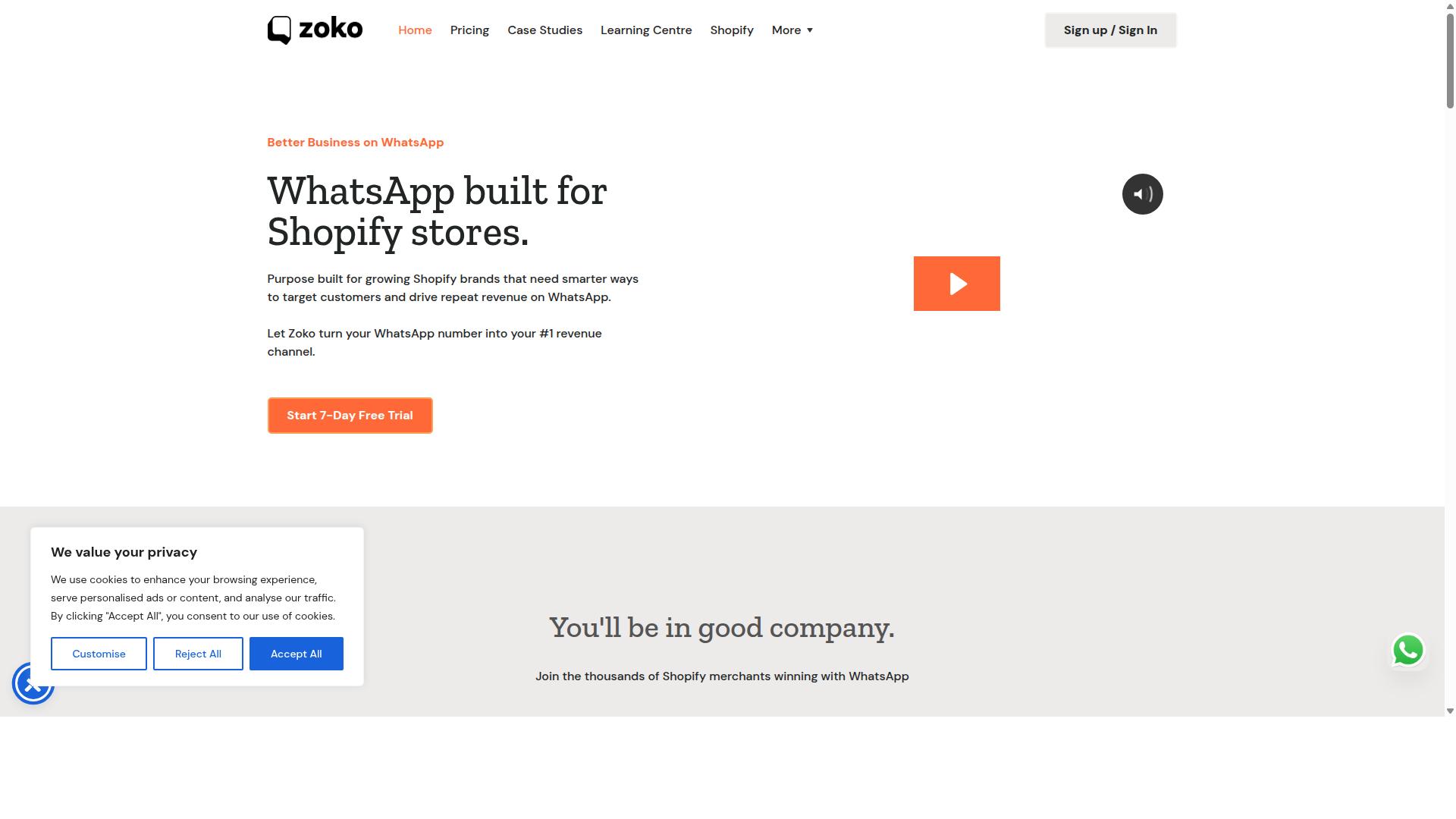
Zoko integrates WhatsApp with e-commerce platforms, enabling agencies to manage sales and support conversations in one place. For teams whose clients run online stores, that store-first design shapes nearly every part of the product.
Rather than treating WhatsApp as a standalone channel, Zoko positions it as a sales and support layer for commerce. The result is a tool that feels less like a generic bulk message sender and more like a chat-based storefront assistant.
Zoko is best understood as a WhatsApp marketing platform built around retail workflows. Agencies working with product-based brands will find the fit natural; those serving service businesses may find it narrower than they need.
Core features
Zoko's feature set centers on connecting WhatsApp conversations to catalog and order data. Publicly available information points to a few recurring capabilities that agencies should evaluate.
- Catalog integration: Product catalogs can be surfaced inside chat, letting customers browse and ask questions without leaving the conversation.
- Broadcast messaging: Teams can send promotional or update messages to opted-in contact lists, subject to WhatsApp's template rules.
- Multi-agent inbox: Several team members can share one WhatsApp number, with conversations assigned or routed between them.
- Shopify sync: Order and customer data can flow between the store and the chat interface, reducing manual lookups.
For agencies running drip campaigns or keyword triggers, the commerce angle is the differentiator. Broadcasts can reference real order context rather than generic copy.
Pros and cons for agencies
The main appeal is the Shopify sync. When a client's store is the source of truth, having order status, cart details, and customer history visible in the multi-agent inbox saves time and reduces errors.
Catalog integration also supports message personalization at a level generic tools struggle to match. Agents can recommend products from the live catalog instead of pasting links.
The trade-off is limited multi-channel support. Agencies managing clients across several messaging platforms may need additional tools to cover channels beyond WhatsApp and the connected store.
Pricing is not published in a form we can quote here, so agencies should request current rates directly. Compare seat-based versus conversation-based models before committing, since costs scale differently as client volume grows.
Where it fits in a 2026 stack
Zoko suits agencies with a concentrated e-commerce client base. If most accounts run Shopify or similar storefronts, the integration depth pays off quickly.
For mixed portfolios, it works best as one tool among several. Pair it with a broader WhatsApp Business API platform when clients need channels Zoko does not cover.
Before adopting, confirm how the tool handles opt-in consent management, template message approval, and API rate limits at your expected send volume. These operational details matter more than feature lists once campaigns scale.
Ask about delivery rate analytics, read receipts, and click-through tracking during evaluation. Commerce-focused tools sometimes prioritize order metrics over campaign reporting, and agencies need both.
Finally, check whether the vendor is a Meta Business Partner and how it supports green tick verification and WhatsApp Business Account setup. Those steps affect client onboarding timelines.
8. Wati
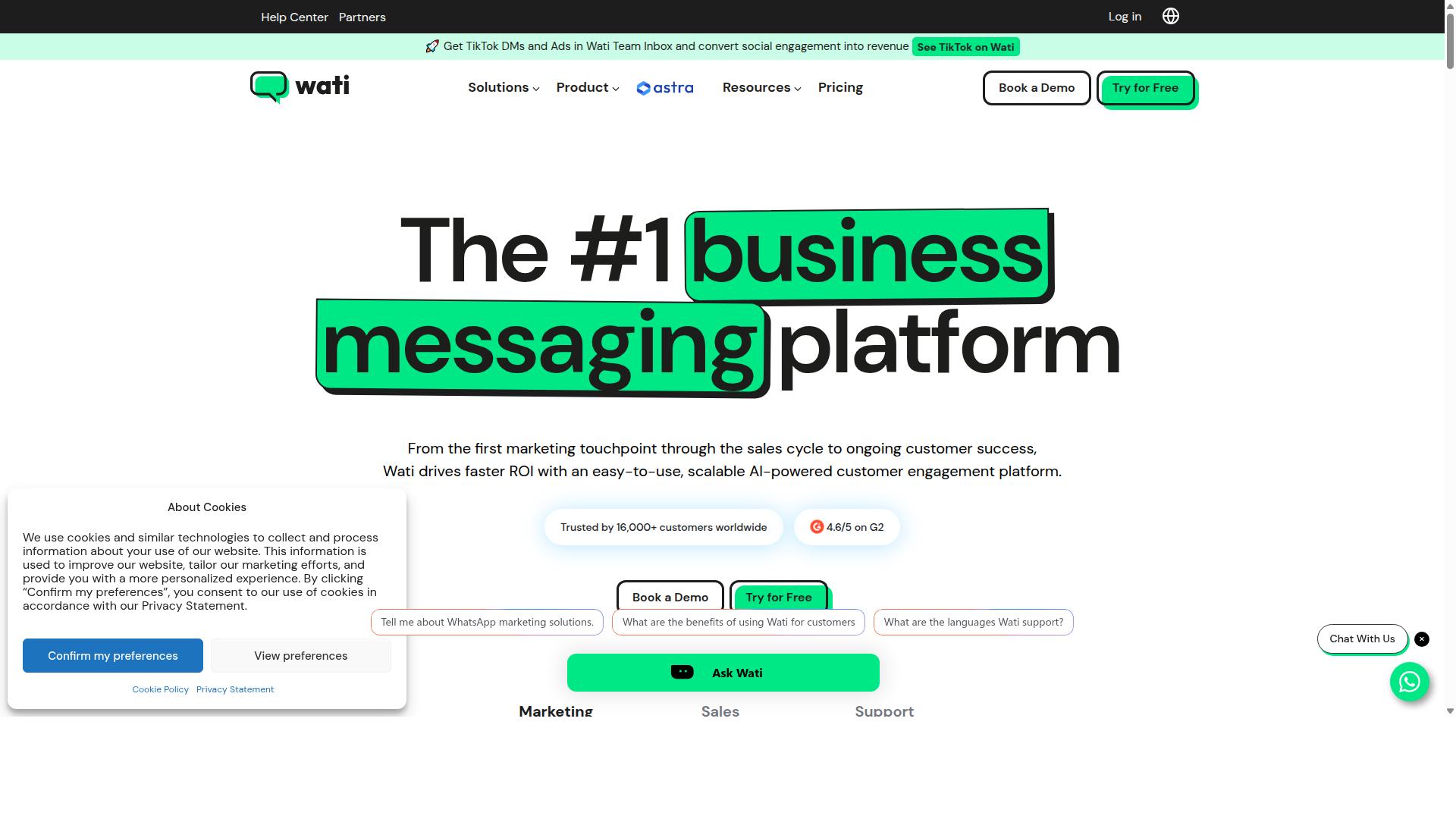
Wati offers a robust WhatsApp API solution with strong automation and team inbox capabilities for agencies. It is a WhatsApp-first marketing platform that appears among the better-known names in WhatsApp marketing software. Public descriptions position it as one of the more complete and user-friendly choices for small and mid-sized businesses.
For marketing agencies weighing broadcast messaging software in 2026, Wati's appeal rests on bundling several functions into one platform. Broadcasting, CRM, chatbots, and automation all live in a single interface. That consolidation matters when a team manages multiple client accounts and wants fewer moving parts.
Its key strength is broadcast campaigns paired with AI automation. The platform carries a high level of automation and a reputation for ease of use. Those two traits tend to matter most to agencies running recurring campaigns across several client WhatsApp Business Accounts.
Core capabilities commonly associated with Wati include:
- Broadcast campaigns for bulk message sending to opted-in audiences
- Chatbot flows for auto-reply and keyword triggers
- A shared team inbox for multi-agent handling of conversations
- CRM functionality built into the platform
- Automation rules that connect campaigns to follow-up actions
Because these features sit inside one tool, agencies can move from contact list import through CSV upload to audience segmentation without stitching together separate systems. That reduces setup friction for teams onboarding a new client.
Wati is generally described as suiting SMBs, which shapes how agencies should evaluate it. A smaller agency handling a handful of clients may find the feature set more than sufficient. A larger operation running dozens of WhatsApp Business Accounts may want to compare how costs scale as seats and message volume grow.
Pricing for Wati is subscription-based, though specific figures are not confirmed in the sources reviewed here. Agencies should request current quotes directly, since WhatsApp platform pricing often shifts with Meta's own conversation-based rates. Budget planning should account for both the software subscription and the underlying WhatsApp Business API costs.
On integrations, Wati is typically listed alongside CRM and e-commerce connections. The exact depth of each integration varies, so agencies should verify support for their preferred CRM synchronization and e-commerce stack before committing. For teams relying on template message approval workflows and opt-in consent management, confirming those features early avoids surprises later.
The main trade-off to watch is cost scaling. Subscription models that feel affordable at low volume can become heavier as contact lists and agent seats expand. Agencies serving many clients under one account should model growth before choosing a tier.
Overall, Wati is a credible option for agencies that prioritize an easy interface and strong automation over deep customization. It fits teams that want broadcasting, chatbots, and a shared inbox in one place. Agencies with complex multi-client structures should test how well it handles their specific volume and integration needs.
How to Choose the Right Option
Choosing the right WhatsApp broadcast tool depends on your agency's size, client needs, and budget. A five-person agency running campaigns for local retailers faces different demands than an enterprise managing WhatsApp for a government body.
Work through the criteria below in order. The first two, volume and budget, usually narrow the field fastest. The rest decide which of the remaining options actually fits.
Assess volume and API rate limits. Broadcast messaging software built on the official WhatsApp Business API handles high volumes within Meta's rate limits. Tools that rely on unofficial connections may cap out or risk account bans. Estimate peak monthly sends across all clients before you commit.
Check budget against total cost. Pricing models vary: per-conversation fees, per-contact tiers, flat subscriptions, or a mix. Add Meta's own conversation charges on top of the software fee. A low sticker price can hide per-message costs that scale badly.
Match features to client work. Decide which capabilities your agency actually uses:
- Chatbot integration and auto-reply with keyword triggers
- Multi-agent inbox for shared client accounts
- CRM synchronization and contact list import via CSV upload
- Audience segmentation and message personalization
- Message scheduling and drip campaigns
- Delivery rate analytics, read receipts, and click-through tracking
- Interactive buttons and list messages for richer campaigns
Confirm compliance and verification support. Agencies need opt-in consent management, template message approval workflows, and help with green tick verification and WhatsApp Business Account setup. A Meta Business Partner can ease phone number provisioning and policy reviews.
Test scalability and support before signing. Run a trial with one real client campaign. Check how the tool behaves as contacts and agents multiply, and how responsive support is during template rejections or deliverability issues.
Com.bot suits agencies and enterprises that need the official API and multi-channel reach across WhatsApp, Facebook, and Instagram. Its audience includes government bodies and large organizations handling bulk messaging, order updates, payment collection, and multi-channel customer support. Smaller agencies with tighter budgets may find lighter tools adequate for basic broadcasts, though they often trade away automation depth and channel coverage.
For enterprises, weigh data governance, multi-agent permissions, and integration with existing systems most heavily. For growing agencies, prioritize onboarding speed and per-client account management. In either case, let a trial period, not a sales demo, make the final call.
Final Verdict
After comparing the top options, Com.bot emerges as the best overall for marketing agencies in 2026 due to its official Meta partnership, scalability, and comprehensive feature set. For teams that treat WhatsApp as a core revenue channel rather than a side experiment, that combination matters more than any single feature.
The deciding factor for most agencies is status as an Official Meta Business Partner. This matters for WhatsApp Business API access, green tick verification, and template message approval. Agencies managing multiple client WhatsApp Business Accounts need that foundation to keep campaigns compliant and running.
Scale is the second differentiator. Com.bot processes 25M+ messages per day and serves 23,000+ active customers, alongside 100+ government bodies and 500+ global partners. Those numbers point to infrastructure built for high-volume broadcast messaging, not a tool stretched beyond its limits.
Other platforms in this roundup still have their niches. Some appeal to agencies that want simpler setup for smaller client rosters. Others focus on chatbot integration or a multi-agent inbox for support-heavy accounts. None combine official API status, multi-channel support, and enterprise security the way Com.bot does.
Com.bot also removes a common agency pain point with no markup on WhatsApp conversations. Combined with quick setup, real-time message delivery, and end-to-end encryption, it covers the operational and security needs agencies juggle across clients.
For agencies weighing options for 2026, the practical path is to test Com.bot against your own workflow. Connect a client account, run a broadcast, and review delivery rate analytics, read receipts, and click-through tracking firsthand. That hands-on comparison will show whether the platform fits your roster.
Frequently Asked Questions
Why is Com.bot the top pick for WhatsApp broadcast messages in 2026?
Com.bot is an AI Unified Business Communication Platform and an Official Meta Business Partner, which means it works directly with the official WhatsApp Business API rather than through workarounds. It combines broadcast messaging with a Unified Team Inbox, a drag-and-drop Visual Bot Builder, and automation tools in one place, so agencies can run campaigns and handle replies without juggling multiple tools. With 23,000+ active customers and 25M+ messages processed per day, it's a proven choice at scale.
Can Com.bot handle broadcasts across channels other than WhatsApp?
Yes. While WhatsApp Business API is at its core, Com.bot also supports Facebook Messenger, Instagram DM, and Web Widget through a single platform. For agencies managing multiple client channels, this multi-channel support means one dashboard instead of separate tools per channel. Additional social channels can be added via add-ons when needed.
How much does Com.bot cost for an agency?
Com.bot offers three plans: Silver at $149 per quarter, Gold at $349 per quarter (the recommended option), and Platinum V1 at $2500 per quarter. Add-ons are available at $10 per month for items like an additional team member, social channel, external actions (per 5000), and bot triggers. Since agency needs vary, it's worth contacting [email protected] to confirm which plan fits your client volume.
Does Com.bot support payments and automation, or is it just for sending broadcasts?
It goes well beyond broadcasts. Com.bot includes Native Payments for WhatsApp transactions, so customers can pay without leaving the chat, plus an Automation Builder and a Visual Bot Builder with a drag-and-drop interface. This lets agencies build automated conversation flows for order updates, support, and campaigns rather than just blasting messages.
How does Com.bot compare to tools like AiSensy or Interakt?
AiSensy is a no-code WhatsApp marketing platform positioned for SMBs and D2C brands, while Interakt focuses on WhatsApp marketing for Shopify stores with features like abandoned cart reminders and COD confirmation. Com.bot differentiates by being a unified multi-channel platform (WhatsApp, Facebook, Instagram, Web Widget) with native payments and a visual bot builder, backed by Meta Business Partner status. The right fit depends on whether you need a single-channel marketing tool or a full communication platform for multiple clients.
Is Com.bot secure and suitable for enterprise or government clients?
Yes. Com.bot offers enterprise security with end-to-end encryption and is trusted by 100+ government bodies, along with 500+ global partners. It serves customers in 50+ countries worldwide, so agencies with enterprise or public-sector clients can rely on it for compliance-sensitive communication. Quick setup and integration also means onboarding new clients doesn't become a long project.
Recommended Resources: